


Ravenswell Primary School doesn’t fit neatly into one box, and that’s rather the point.
It’s a Catholic school under the local diocese, government-funded, home to around 450 students spread across three classes at every year level – plus two–three classes dedicated to supporting children with additional needs – and a socioeconomic mix that runs, as classroom teacher and assistant principal Joe Smyth puts it, “from upper social echelon… to medium and low.”
Ravenswell holds DEIS Band 1 status (DEIS stands for Delivering Equality of Opportunity in Schools, the Irish government’s programme for schools in disadvantaged areas; Band 1 marks the highest level of need and funding), meaning it’s a demanding place to teach. It’s also, as it turns out, exactly the kind of school where Mathletics has had room to prove itself.
Joe would know. A Mathletics veteran, he’s used the programme for close to two decades – long enough that he’s stopped counting – first in the one-to-one laptop schools he taught in across Australia, then, once he returned home to Ireland, at Ravenswell itself. And it was that experience, knowing firsthand what the programme could do, that gave him the confidence to bring it into a school that wasn’t using it at all when he arrived.
What started with a small batch of licences, has grown every year since, and today Mathletics runs across First, Second and Third Class, with another year level joining this year.
“So far, everybody’s been very pleased with it… all the teacher feedback we’ve got so far has been very positive.”
Let’s look at how it started shifting the numbers that matter most, too.

The challenge
As is often the case in many schools, literacy had always drawn more attention at Ravenswell than maths. There’d been a hands-on programme for teaching it early on, but nothing carried past Junior and Senior Infants [ages 4 to 6] – after that, each year level was left to sort it out on its own, mostly with textbooks, with nothing holding it together as a whole-school approach. When it comes to numeracy scores, Joe wouldn’t call them bad – they just weren’t being watched or supported in the same way literacy was.
Then there’s the layer that comes with DEIS Band 1 status:
every euro spent has to be justified with evidence, not enthusiasm.
And accessibility cuts deeper than budget – you simply can’t assume a family has a device sitting at home, ready to go, so homework was never really viable in the usual sense. Tasks were assigned at the start of the week, with class time built in alongside, so every child got a fair shot at finishing regardless of what waited for them after school.
Layer on top of that a school where needs run the full range – behavioural, learning support, social, often all three in the one classroom – and “one thing that works for everyone” was never really on the table.

The solution
Getting Mathletics into classrooms was the easy part. Getting it to stay at a DEIS Band 1 school, where every implementation has to be data-driven, took proof – and proof was exactly what Joe got.
He started small and low-stakes: the first licences went to the support groups he was already running, small clusters of pupils working outside the main class. It gave him room to test the fit without asking the school to bet on anything. It also didn’t hurt that Mathletics was already written into Ravenswell’s DEIS plan – had been for a few years, in fact, just never implemented. Joe’s timing happened to land right as that part of the plan was due to move ahead.
At the end of that first year, he saw results:
“We were looking at addressing our numeracy scores, and our numeracy scores did go up in the third class test year… there was improvements, and some significant improvements for some students,” Joe says.
That was enough. “When I was able to justify the cost after the first year and we showed the improvements,” he explains, “I said we can expand it out to all three classes in that year level.”
And that’s the pattern that’s repeated every year since. Joe gathers the data, brings it to management and asks for more: another class, another year level, another round of licences.
When we peek into the platform’s own numbers, we see a similar story of growth: Ravenswell pupils’ activity scores climbed by an average of 17.69%, comparing where they started with where they finished.
“So it was basically driven on the data… the management were supported, but the other teachers were supportive of it too.”
Part of the reason it’s stuck is that Mathletics works with the way Joe already teaches, not against it – “very teacher-friendly,” as he puts it.
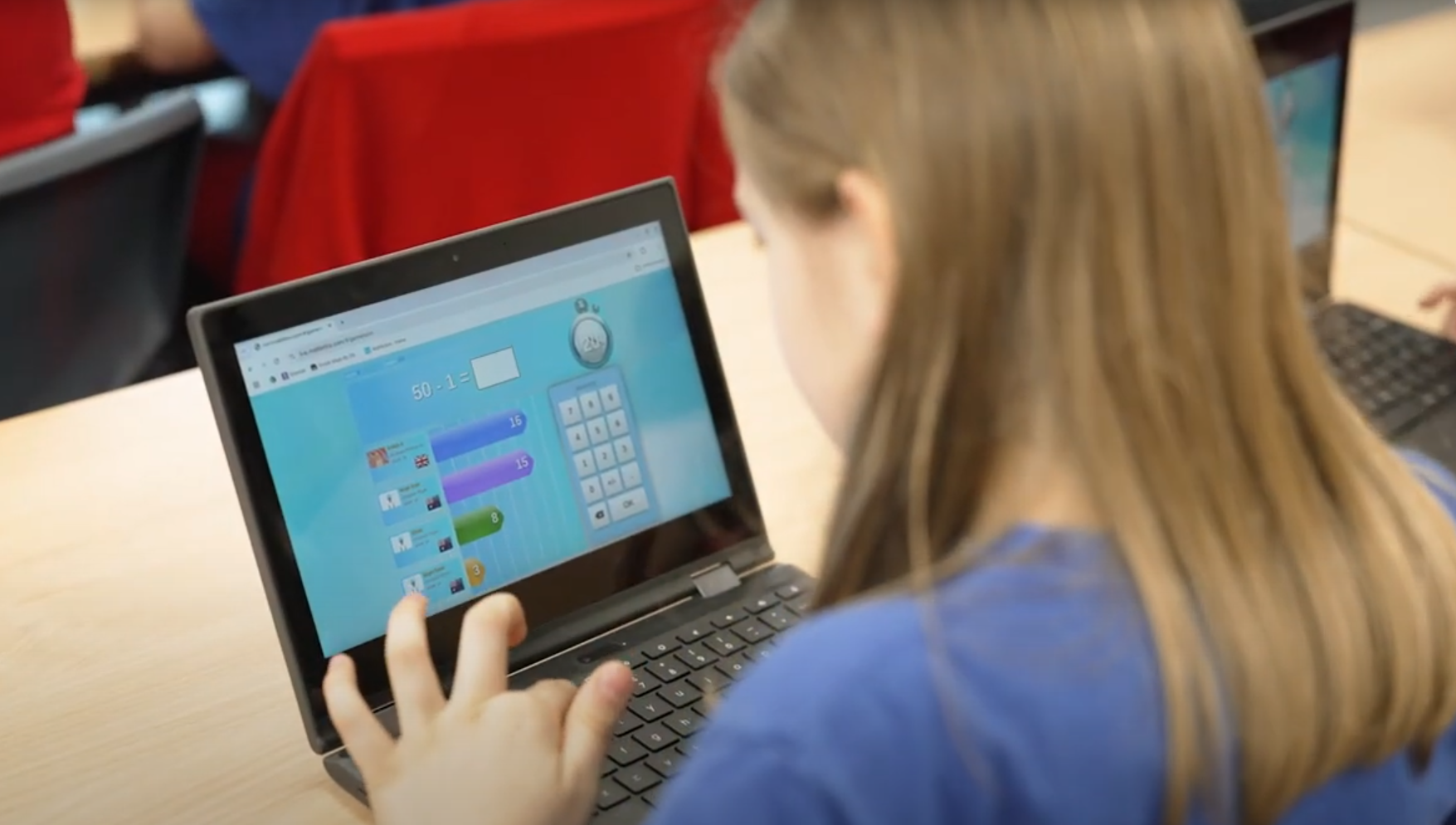
Live Mathletics does some useful work here too: pupils play head-to-head against classmates, each working at their own level, with nobody any the wiser about who’s ahead and who isn’t. As Joe puts it,
“it allows those kids to build a sort of confidence: ‘I’m not too bad at maths, I can do this’.”

The impact
While the numbers show progress, Joe believes the shift in attitude might be even more significant.
He describes kids at the start of the year who write themselves off before they’ve even tried – the usual refrain, something like ‘I’m rubbish at this, I’ll never be good at maths’. Somewhere along the way, on Mathletics, that story starts to crack. “So the motivation is there,” he says, and it shows:
“The kids’ general level of engagement was brilliant and really enthusiastic.”
That matters more in a school like Ravenswell than it might elsewhere. When a child is already carrying more outside the classroom than most, confidence is often the thing standing between them and engaging with the subject at all.
Even though Joe saw ‘a good jump in the numbers’, the improvement wasn’t uniform, and Joe’s candid about that. “We’ve seen improvements through the middle and lower middle cohort in the classes… we’ve seen it now over two year levels that it has improved it,” he says. But for the small number of pupils facing the steepest challenges, isolating what Mathletics did versus everything else going on in their lives is harder to untangle, and he doesn’t pretend otherwise.
A few features have done particular work for a cohort this diverse:
- Read-aloud support: “I think one of the best benefits is that it reads it to them,” Joe says – removing the reading barrier that often gets in the way of maths for students who struggle with text.
- Built-in differentiation: “the main thing is being able to set the different levels within the classroom” – support, extension, everything between, without a single child knowing which group is which.
- Focused consolidation: hands-on teaching runs Monday to Wednesday; Thursday and Friday belong to Mathletics, tied to whatever’s just been taught.
- A clearer view of the class: “Teacher side is great because you just get to see an overall picture of your class,” helping teachers spot gaps at a glance with the traffic light system rather than waiting for an assessment.
- Marking, handled: “it’s a time saver as well… it’s obviously marked for you, so you’re not marking work.”
One year of Mathletics at Ravenswell – by the numbers
- 5,443 student logins
- 17,001 curriculum activities completed
- 1,768,292 curriculum points earned
- 930 certificates awarded
- An average of 10 hours and 58 minutes online, per pupil, across the year
- +17.69%: average activity-score improvement since Ravenswell started using Mathletics, comparing each student’s first activity score to their most recent (as of June 2026)
The verdict
We asked Joe for a number, and he didn’t hesitate: nine out of ten. The missing point isn’t about learning at all, but rather a technical wish list item.
At Ravenswell Primary, one extra year level became another, and then another. This year marks the school’s fourth expansion of Mathletics in four years, driven by what staff were seeing day to day, each one earned the same way: with evidence, brought back to management, one class at a time.
See what Mathletics can do for your school
A DEIS Band 1 school or not, every classroom has pupil starting from different places. Mathletics is built to meet them there – and help every learner move forward.
Trusted by 200,000 educators and loved by 3 million students worldwide, Mathletics is proven to drive measurable maths gains with just 15–30 minutes of use a week.